How to support the use of the intervention in customer work?
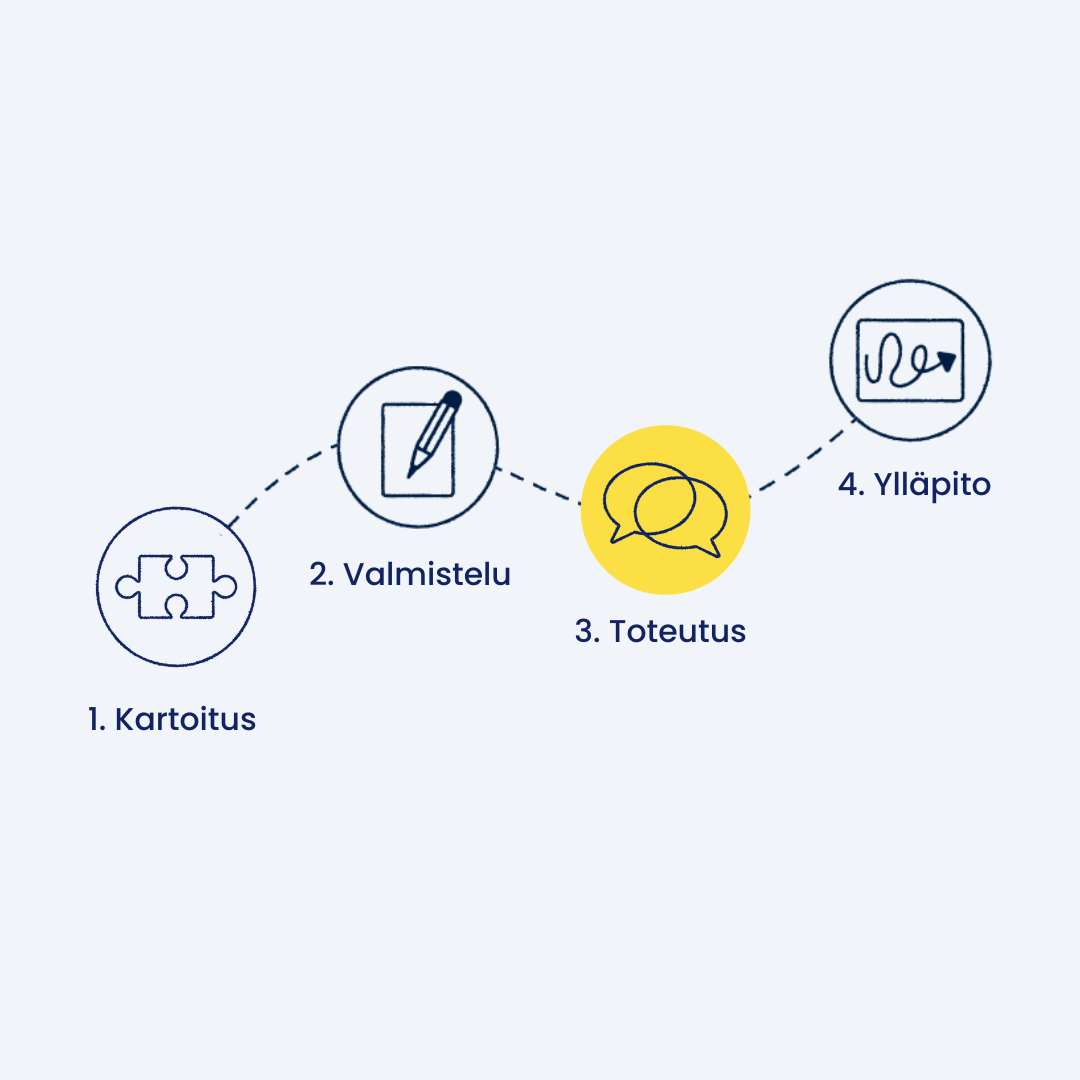
In the implementation stage, it is important to focus on supporting the progress of the implementation of the psychosocial intervention and its success in various ways.
When the use of the intervention begins, the change becomes real, which means that new factors may emerge as facilitators or barriers to implementation. This may make it necessary to amend the implementation plan at this stage.
1. Supervisors support employees in the change
The significance of immediate supervisors is emphasised in the implementation stage, as they act as a link between senior management and employees. Their task is to ensure that employees have a genuine opportunity to use the intervention as part of their work.
The supervisor can support the employees in the use of the interv ention not only by providingassistance and guidance in practical matters but also by inspiring and motivating them to use the intervention.
Opportunities for discussion and interest shown by the supervisor support employees in the early stages of using the new intervention. Regular interaction ensures that the goals are kept in mind and that any needs for changes can be discussed.
It is important to listen to the employees’ experiences and take them into consideration. Experiences related to the use of the intervention can be collected systematically, for example by means of surveys or as part of team meetings, but also in everyday encounters.
2. Building trust through communications
The new intervention and its implementation must be communicated in a diverse and extensive manner. Communications must not be limited to the mere dissemination of information. Instead, communications must be interactive, continuous and multi-channel in nature.
The key is to collect feedback regularly, listen to the employees and different stakeholders, and create space for open discussion. This way, the concerns of employees and various stakeholders can be identified at a sufficiently early stage, which strengthens confidence in the organisation’s capacity to drive the change forward.
3. Cooperation with change agents
Change agents are employees in the organisation who promote the implementation of the new intervention by speaking in favour of it and setting an example.
Through their own enthusiasm, change agents increase the motivation and commitment of others with regard to the use of the intervention by sharing with others what they know about the intervention, how they have used the intervention and what kinds of benefits can be expected from using the intervention.
The strength of change agents lies in the fact that they are close to the organisation’s day-to-day operations and have a better understanding of the employees’ perspective. It is easier for them to notice when employees need encouragement and support in the use of the intervention.
It is advisable for the supervisor to cooperate with change agents and listen to their observations.
4. Support from the purveyor organisation
External support for the implementation and use of the intervention can be obtained from the purveyor organisation, for example. Cooperation with the purveyor organisation in the implementation stage supports successful implementation.
In addition to producing training on the intervention, purveyor organisations often produce various materials that are necessary for the use of the intervention or communications about it. They also provide supplementary training and refresher training for professionals trained in the intervention.
Support can vary depending on the intervention – the purveyor organisations of some interventions only provide training in the intervention and related materials, while others provide more active implementation support and networks.

The pillars of implementation
Main tasks:
- monitor the progress of training
- monitor the use of the intervention
- ensure that employees have the support they need for using the intervention
Responsibilities: The core implementation team should meet regularly and be prepared to react to any challenges, even ones that arise quickly. This requires that working time is systematically allocated to the tasks of the core implementation team, which needs to be taken into account in the organisation’s other activities. Coordinators facilitate and support the work of the team.
Knowledge and capabilities required: Change management capabilities are needed in particular. Immediate supervisors play an important role in supporting employees during the training and the initial stages of the use of the intervention.
- Ensure that it is clear to everyone what, why and how the implementation process is monitored.
- Provide adequate support for the personnel’s motivation, capabilities and opportunities.
- Give feedback in a reciprocal manner and react to it by making necessary and potential changes to the implementation plan and its execution.
- Lead by example at all levels of management: interest and commitment start from senior management. Ensure that the implementation of the intervention is perceived as a collective effort.
- Give time for the change and take an understanding view of challenges: the implementation of a new intervention does not happen overnight.
Data on the use of the intervention and the progress of its implementation is monitored in accordance with the implementation plan. The data is reacted to and, if necessary, changes are made to the plan or the instructions for making entries, for example.
The execution of follow-up and tools
- Ensure that reliable and up-to-date information is accumulated on the use of the intervention.
- Besides data accumulated in systems, other information on the use of the intervention is also valuable. For example, weekly meetings or discussions during coffee breaks can present opportunities to discuss the employees’ thoughts on the use of the intervention.
Making entries in the client information system
- Ensure that employees receive training and instructions on making entries on the use of the intervention and the code required for its national monitoring.
- Data collected on the use of the intervention can be monitored via the overview of mental health services developed by Itla and the National Institute for Health and Welfare if the intervention has a procedure code.