How to start the exploration of needs and interventions?
When a psychosocial intervention is implemented systematically, it delivers many benefits: children and adolescents get the help they need to support their mental health, the organisation’s resources are used sensibly, and the implemented intervention remains in use in the long term.
Making a new intervention well-established requires several years of systematic and committed work with a long-term approach, and it is not always possible to define a clear start or end for the process. Learning an intervention and integrating it into the work takes time, and it is important to prepare for this.
The implementation of interventions also requires extensive cooperation between different professionals. A common and shared understanding of the intervention, the need for it and the progress of the process promotes its implementation and establishment.
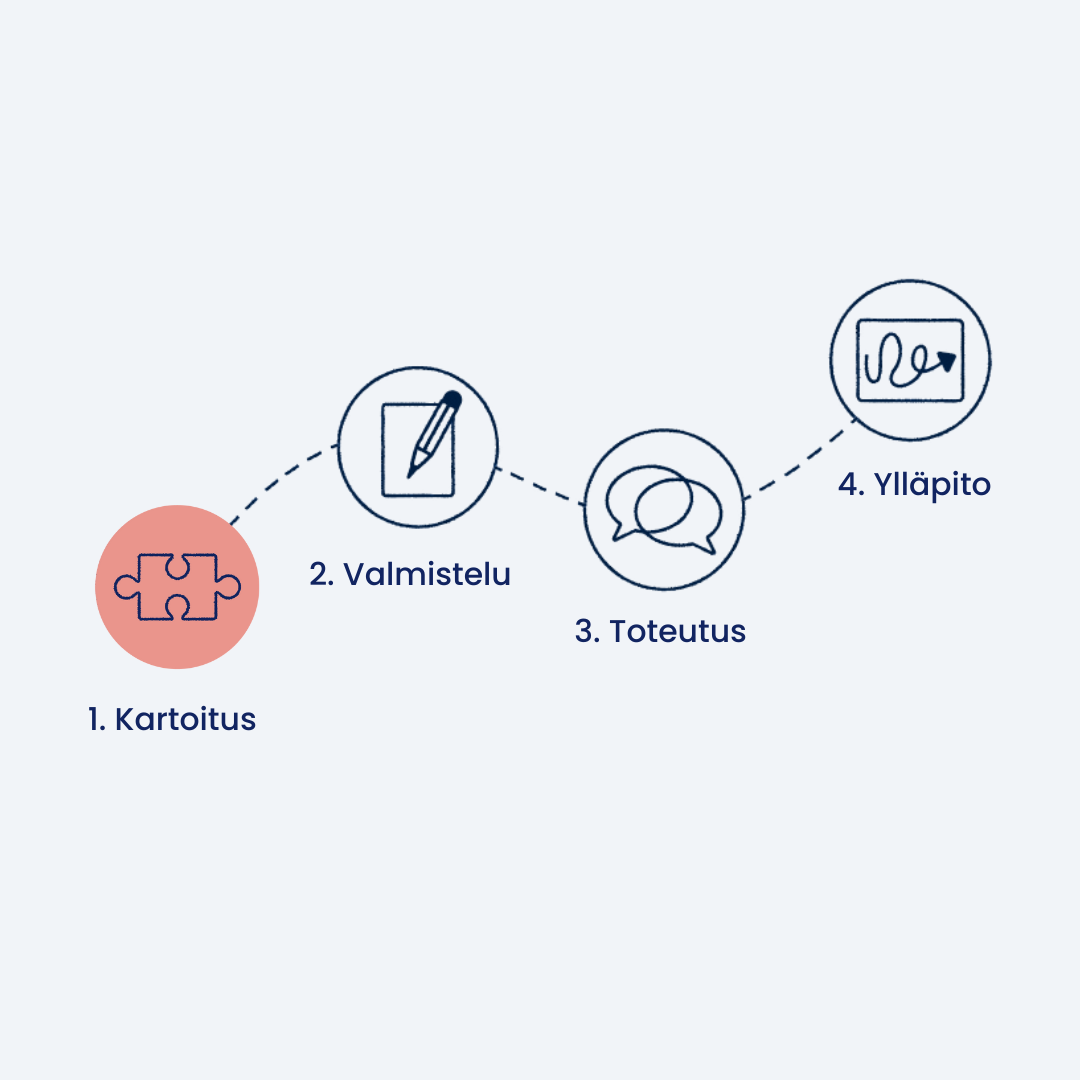
1. Identifying the need
The exploration stage begins when a wellbeing services county or other organisation identifies a need that they decide to address with the help of a psychosocial intervention. The need may be related to strengthening the mental health or social skills of children, adolescents or families, for example.
Epidemiological data, monitoring statistics and the latest research and survey data can be used to identify the need. Information about the need can also be gathered through less formal routes.
2. Exploration of potential interventions
Interventions that address the identified need must be carefully explored.
When exploring interventions, it is important to determine what ta get group the intervention is intended for, what information is available about the usability of the intervention, and how the intervention is expected to suit the planned context of use. Many interventions have been developed outside Finland, which makes it important to ensure their applicability to Finnish culture and services.
The intervention also needs to be well-documented to provide information on what kind of intervention will potentially be implemented. At a minimum, its description should specify the intervention’s target group, goals and implementation practices. Implementation support provided by the purveyor organisation should also be assessed.
It may be that there is already an intervention in use in the region for the identified need, and the implementation of a new intervention is not necessary. In this case, strengthening existing expertise through refresher training or supplementary training may be helpful in addressing the need.
3. Selecting an intervention
When the need has been identified and the available interventions have been explored, the next step is to select the intervention.
The selection of the intervention to be implemented can be viewed from multiple perspectives. Senior management and supervisors may have different perspectives and selection criteria than employees, customers or researchers. With this in mind, it is recommended that the decision on the selection of the intervention to be implemented be made through broad cooperation.
The decision on the implementation of an intervention can be made when it has been confirmed that the intervention is effective and usable for the target group concerned, suitable for the context of use, and that is addresses the specified need. In selecting an intervention, it is important to ensure that the need, intervention and available resources correspond to each other.
Adaptation, which refers to the systematic modification of an intervention, can improve an intervention’s fit with the service context. Learn more about adaptation here.
Information on psychosocial interventions is available from national operators, such as:
- Itla, Early Interventions intervention bank
- National Institute for Health and Welfare, interventions for children and adolescents
- Training providers and purveyor organisations of interventions
- Current Care Guidelines
- The evaluation of evidence-based practices in health and well-being promotion, National Institute for Health and Welfare
- NRF Clinical Practice Guidelines
- Service choices in healthcare, Ministry of Social Affairs and Health
Itla’s Early Interventions produces evidence-based information on the effectiveness of psychosocial interventions. Learn more about the intervention bank.
4. Forming implementation teams
At the beginning of the implementation of the intervention, it is advisable to form two implementation teams, i.e. working groups whose task is to plan, participate and be responsible for the selection, implementation and monitoring of the use of the psychosocial intervention.
With the help of implementation teams, an intervention is more likely to be successfully implemented and become well-established as part of the organisation’s operations.
In the literature and in cooperation with experts from wellbeing services counties, two different kinds of implementation teams that support the implementation of interventions have been identified:
- Administrative implementation leadership team:
- is responsible for the implementation processes of interventions
- makes decisions on the interventions to be implemented
- is responsible for the sustainment of the use of interventions and their monitoring as part of management.
- Core implementation team:
- plans and carries out the implementation of a single intervention.
Read more about how to form both teams.
5. Assessing the organisation’s readiness for change
The implementation of a new intervention always means a change in the organisation’s operating and working practices, and the readiness for change varies depending on the organisation’s situation. The organisation’s readiness for change refers to its capacity, willingness and resources to carry out the change required by the implementation of the intervention.
One part of the exploration stage in the implementation of an intervention is to assess whether the conditions are in place at this time for the successful implementation of the new intervention. When a lot of development work goes on, it tends to happen that many new interventions or operating models are implemented concurrently.
It may also be the case that one unit has several implementation processes under way, and the employees feel that they cannot focus on learning new practices to the extent they would want to.
The different dimensions of the organisation’s readiness for change
- Psychological readiness: The organisation must have a common understanding that the intervention and the changes it involves are necessary. The success of implementation is supported by the employees having the perception that the change and the intervention will support their work and yield benefits for customers.
- Structural readiness: The resources available to the organisation, such as time, IT solutions, budget and employees, that are necessary to implement the change.
- Cultural readiness: The organisation’s culture, customs and values. A flexible and innovative organisational culture makes it easier to embrace change, while rigid and inflexible practices can slow down the process.
6. Preparing for costs
The implementation of an intervention requires preparing for various costs that must be taken into consideration and prepared for during the preparations for implementation. The costs can vary depending on the organisation and the intervention to be implemented.
When the decision on the implementation of the intervention is being made, it is important to understand what the significant costs are and how to gather information about them as the implementation process moves forward.
Direct and indirect costs
The most obvious costs are direct costs related to human resources, training in the intervention and various purchases or necessary technical solutions.
In addition to direct costs, the implementation of an intervention generates indirect costs as employees’ working time is used for training and guidance related to the intervention, or when customer meetings are not carried out as usual and queues may arise. The management and planning of implementation also takes up time for various parties involved.
The methods of implementation have an effect on costs
The methods of executing the implementation process can influence costs. At different stages of implementation, it is advisable to consider what is the most economical and efficient method to carry out the implementation.
Implementation should be seen as an investment in the future. The benefits of a well-executed implementation become evident later on as health benefits or improved wellbeing for customers, for example.
Costs to take into account in implementation
- Human resources: the number of trained employees, working hours spent on training related to the intervention, and the total human resources required for the use of the intervention
- Implementation support: participation and travel costs incurred from training, costs of guidance on the use of the intervention and, for example, the fees of an external training provider
- Purchases and maintenance costs: equipment, facilities, technological solutions and required software, as well as any upgrade and integration needs related to other software used
- Material costs: material distributed to employees and customers, or material required for communications

The pillars of implementation
Main tasks:
- identify the need that the intervention is intended to address
- explore the available interventions and select the most suitable one
- evaluate the organisation’s readiness to implement the intervention and sustain it with a long-term approach
Responsibilities: The administrative implementation leadership team makes the decision on the intervention to be implemented. Coordinators facilitate and support the operations of the administrative implementation leadership team and prepare meetings as necessary. The administrative implementation leadership team may meet infrequently.
Knowledge and capabilities required: Decision-making needs to be supported by capabilities and knowledge particularly with regard to evidence-based psychosocial interventions, the organisation’s strategy, resources, implementation, the content of services, customer paths, employee competence and additional training.
- Ensure that there is adequate time and resources for the implementation of the new intervention and that it does not create an excessive burden on employees or supervisors.
- Assess the organisation’s capabilities and the personnel’s capabilities, motivation and opportunities to use the new intervention.
- Communicate the change that is about to happen transparently and clearly so that it is clear to the personnel where the organisation is going, how, and why.
- Show appreciation for the personnel by listening to their experiences and views.
Explore the capabilities of the organisation and what capabilities are necessary for monitoring the implementation and use of the new intervention.
The monitoring is carried out in cooperation with the organisation’s information management professionals.
The execution of follow-up and tools
- Determine what data the purveyor organisation or training provider collects and manages.
- Determine what indicators are required for the use of the intervention, and what kinds of other indicators are needed.
- Explore how feedback can be collected during implementation from both employees and customers.
- Also explore other data collection practices and opportunities that can be utilised in addition to the data accumulated through information systems.
Making entries in the client information system
- Check whether the intervention has been assigned a code necessary for national monitoring. The term “procedure code” is used in healthcare services to specify procedures
carried out by professionals. In the structural data entry guidelines for social welfare services, the term “code” is used to specify the content of a service task. More information on the codes is available on the website of the National Institute for Health and Welfare. - Determine whether there are existing instructions for recording entries on the use of the intervention, either in the wellbeing services county or nationally.