How to manage the implementation of an intervention?
Implementation management may sound formal but, at its core, it is no different than management in general: guiding people towards certain goals.
At its simplest, change means that someone needs to do something differently. This may sound simple, but managing change is not necessarily easy.
The successful implementation of an intervention is dependent on behavioural change at every level of the organisation. Senior management, implementation teams, supervisors and employees, i.e. the users of interventions, must change their habitual behaviour in order for the new intervention to become well-established as part of the organisation’s operating practices.
It has been estimated that only about half of research-based psychosocial interventions are implemented in an ideal manner. At its longest, it can take several years for their use to become well-established. The way the implementation process is managed plays a significant role in its success and the outcomes achieved.

The elements of the successful implementation of an intervention
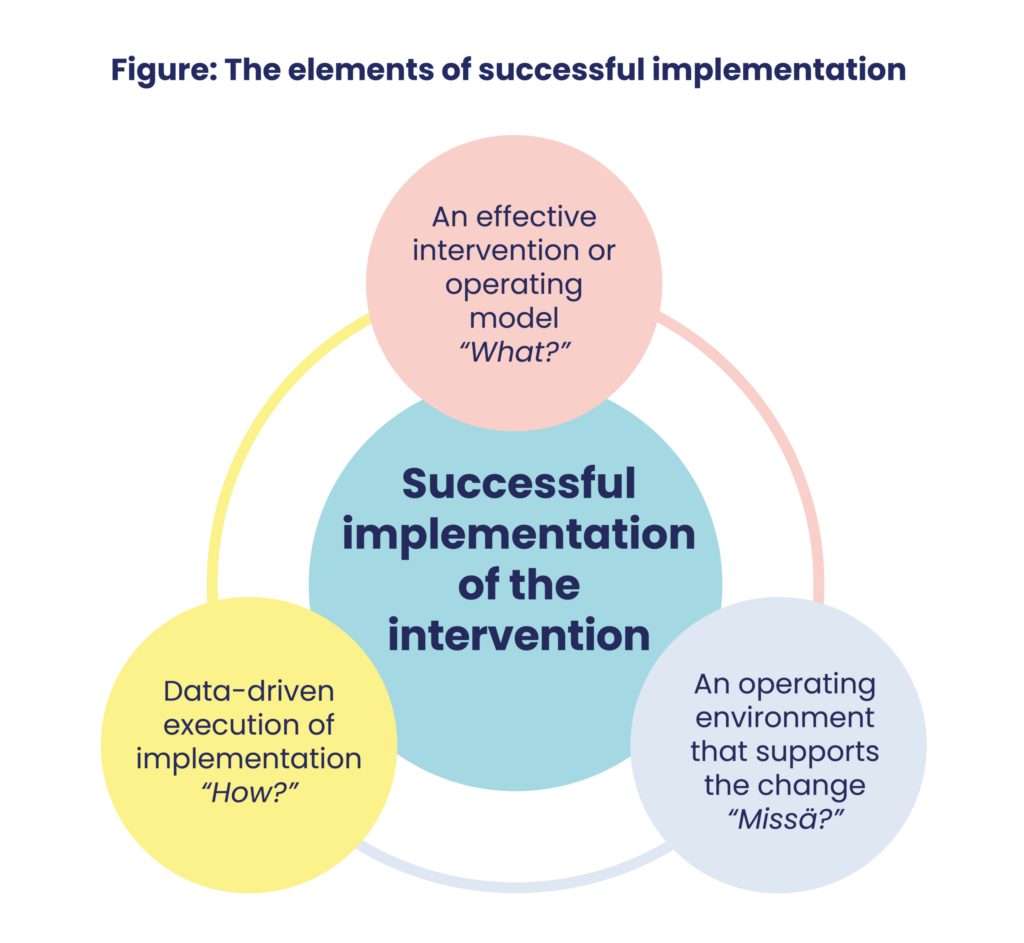
In the implementation of a psychosocial intervention, attention is often focused on the operating model or intervention being implemented. However, the management and execution of the implementation process and due consideration for the operating environment are equally important factors that predict the success of the implementation of the intervention and the extent to which it becomes a well-established practice.
Taking all three of these elements into account helps to achieve the broader objectives set for implementation, such as better mental health for children and adolescents, or more societally effective services.
The three most important questions for the successful management of implementation are as follows:
- What intervention or operating model will be implemented?
- How will the implementation process be carried out?
- In what operating environment will the implementation take place?
Figure: The elements of successful implementation
More information on the selection of the intervention and taking the operating environment into account is provided on the page that covers the exploration step.
A change in operating practices starts with defining the goal
The implementation of a psychosocial intervention aims to achieve a change in the way employees work and operate. That is why it is essential to understand how people operate and why people operate the way they do.
When we better understand the reasons behind behaviour, we are also able to better manage people’s actions towards the goal. Whom the change concerns and what each person concerned needs to do differently must be clear to the person in charge and all of the employees. This means that the goal must be precise, understandable and capable of being monitored.
It is essential to determine the following in a systematic manner:
- What kind of behaviour is the goal?
- What factors influence the desired behaviour?
- How should behaviour be changed to align it with the goal?
- Who needs to do what, when, where, how often, and with whom, to make the change in behaviour happen?
When the goal is clear, we can determine which things in ourselves and around us not only enable but also prevent the desired behaviour. The monitoring of implementation also becomes easier when the goal is expressed in a form that can be monitored.
The COM-B model supports management
Widely used around the world, the COM-B model helps to identify factors that facilitate and hinder a change in behaviour.
COM-B stands for capability, opportunities, motivation and behaviour.
The COM-B model helps supervisors support the capability and motivation of employees to use the new psychosocial intervention and ensures that they have the opportunity to use it.
Simply put: In order to ride a bicycle, you need to have the capability to ride a bicycle, a desire or reason to ride a bicycle, and a bicycle to ride.
Figure: COM-B model
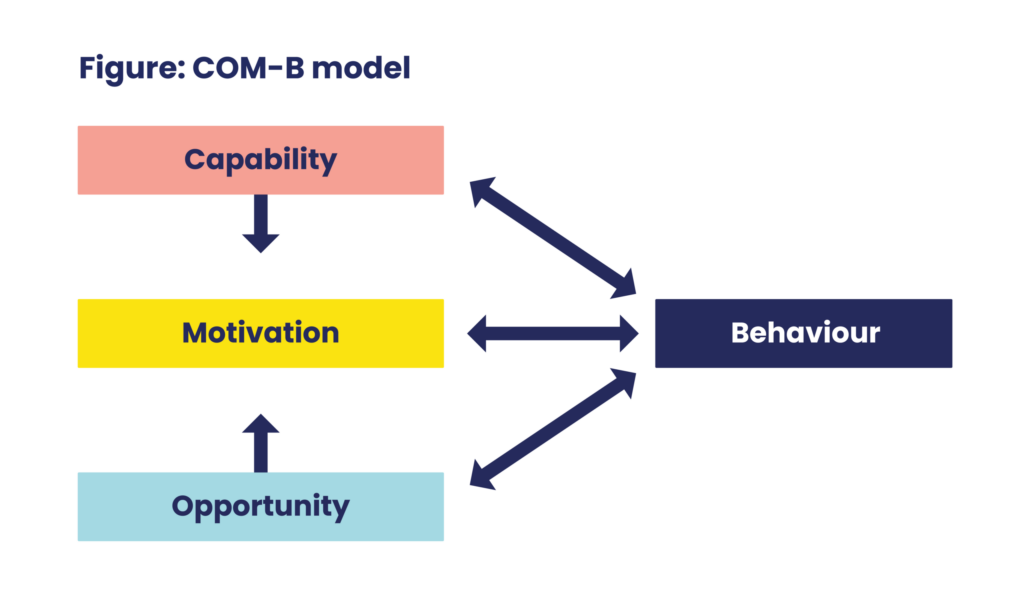
The arrows in the figure illustrate the interactions between the different parts of the COM-B model. For example, using a new psychosocial intervention in customer meetings strengthens capabilities related to the intervention, which, in turn, usually provides motivation to practice using the intervention more. Similarly, increased opportunities to use the intervention can feed motivation.
The most typical ways of supporting capability, motivation and opportunities to use a psychosocial intervention are discussed below.
1. Supporting capability
At the core of capability are people’s knowledge and skills related to the psychosocial intervention and its use: how, where and when is the intervention used?
The most natural way to start the implementation of the intervention is training that helps strengthen the employees’ knowledge and skills. When it comes to designing training activities, the key is to have the best possible information on what kind of capabilities the personnel have and what capabilities they lack. This way, the training can build new capabilities on top of existing ones.
Capability can also be supported with the help of various supplementary training activities, exercises, support materials or briefings, for example.
Nevertheless, supporting capability alone is not necessarily enough to achieve change if the personnel does not perceive the issue as important or if they lack the opportunity to practise the new operating practices after training.
2. Strengthening motivation
In everyday language, motivation is usually understood to mean that we have little, a lot or no motivation for different things. However, motivation stems from many different sources and can differ in quality. This means that a person can have many different reasons for using or not using a psychosocial intervention.
- Reflective motivation enables a person to consider their own goals and the various consequences of their own behaviour as well as, for example, the significance of having the capability to use the new psychosocial intervention for their professional identity or belief in themselves.
- Automatic motivation encompasses various emotions and habits whose significance at the moment of action may be difficult for a person to explain rationally to themselves. Learning a new intervention may feel difficult or demanding, but there may also be other unconscious factors at play.
When it comes to fostering motivation, it is also useful to differentiate between controlled and autonomous motivation.
- Controlled motivation is based on obligation, i.e. doing something due to external pressure and feeling like there are no alternatives to doing it. This kind of motivation is traditionally fed by the “stick or carrot” approach. This kind of motivation may inspire for a moment, but it often does not lead to long-term changes.
- Autonomous motivation, in turn, arises from within the person: the goals feel important, suitable to oneself and one’s professional identity, valuable and worth pursuing. Autonomous motivation is more likely to lead to commitment to the change.
The cornerstones of the development of autonomous motivation
Also in the context of implementing psychosocial interventions, the key cornerstones for the development of autonomous motivation are basic psychological needs:
- competence (“I know what happens in the implementation process and why it is done”)
- autonomy (“I notice that my opinions and capabilities matter”)
- relatedness (“I am accepted and appreciated in this workplace community”)
All of these needs can be supported and strengthened through management.
In supporting competence, the key communication principles are clarity and guidance. Employees must be aware of clear structures within which the implementation is carried out and in which they operate. A jointly defined direction and goal for the change are important, as is adequate support in the different stages of implementation on the path towards the desired change.
Support for autonomy includes giving people the feeling of being heard at different stages of implementation and the feeling of having had the opportunity to participate in decision-making concerning oneself, and also being given responsibility for putting the change into practice for one’s part and in one’s own way.
Showing trust and being heard also increase the sense of relatedness and the feeling that the implementation of the psychosocial intervention is a collective effort.
3. Ensuring opportunities
In the context of the implementation of psychosocial interventions, opportunities to use the intervention means, among other things, that employees wish to have concrete support for allocating adequate time in their calendar to study and practise the new intervention and participate in guidance meetings that support the use of the intervention, for example.
In practice, it has also been observed that the use of the new intervention sometimes becomes more difficult if the availability of tools or materials required by the intervention is inadequate or nonexistent.
Opportunities are, therefore, any factors in a person’s physical or social environment that are facilitators or barriers to the new behaviour, such as the day-to-day use at work of the intervention being implemented.
Often, employees have a need to hear that they are allowed to allocate working time to learning to use the new intervention and that they have the supervisors’ support for this. It is also useful to communicate to the employees that the organisation has a broad commitment to the implementation of the intervention.
The workplace community having a supportive atmosphere and team spirit increase the feeling of having a shared goal and making a collective effort.
Key questions to support behavioural change
Capability
- Do the employees have sufficient skills and knowledge to use the new intervention?
- What capabilities, or what kinds of capabilities, are missing? Why is that?
Motivation
- Is the implementation of the intervention perceived as important? Why or why not?
- Is the intervention a good fit with the employees’ professional identity, and do they feel that the intervention promotes their professional goals? Why or why not?
- Do the employees have confidence in their ability to use the intervention? Why or why not?
- What kinds of emotions does the change arouse and why?
Opportunity
- Do the employees have access to adequate resources (e.g. time, equipment)? What do they need?
- Do any aspects of the environment hinder the use of the intervention?
- How do the other members of the workplace community act?
- What kinds of habits or norms are there in the organisation?
- What kinds of impacts do they have?
Michie, S., Atkins, L. & West, R. 2014. The Behaviour Change Wheel. A Guide to Designing Interventions. Silverback Publishing. Iso-Britannia.
Michie, S., van Stralen, M.M. & West, R. 2011. The behaviour change wheel: A new method for characterising and designing behaviour change interventions. Implementation Sci 6, 42 (2011). https://doi.org/10.1186/1748-5908-6-42
UKK-instituutti. 2025. Käyttäytymisen muutosypyörä. https://ukkinstituutti.fi/elintapaohjaus/edistamismallit/kayttaytymisen-muutospyora/
Public Health Wales WHO Collaborating Centre. 2022. A guide to using behavioural science. https://phwwhocc.co.uk/wp-content/uploads/2022/11/A-Guide-to-Using-Behavioural-Science_ENGLISH.pdf