
Adaptation clinic provide support for adapting an intervention
The adaptation of psychosocial interventions is still relatively new in Finland. Planned adaptation can improve an intervention’s fit with children and adolescents, the professionals who use the intervention, and the service system.
In our adaptation clinic concept, our experts provide support for the adaptation of well- documented psychosocial interventions aimed at children, adolescents and families. Adaptation clinic is free of charge and open to all organisations that adapt psychosocial interventions, including intermediary organisations and, researchers.
What do our adaptation clinic offer?
- We provide support in the planning, conducting and documentation of adaptation.
- We provide guidance on the use of adaptation tools.
- We can take a partial role in the planning, conducting or documentation of adaptation.
Are you interested in our adaptation clinic concept? Get in touch with us!

What are the steps of cooperation in our adaptation clinic?
Before the start of clinic work, we request that you complete a description of the intervention that will be adapted.
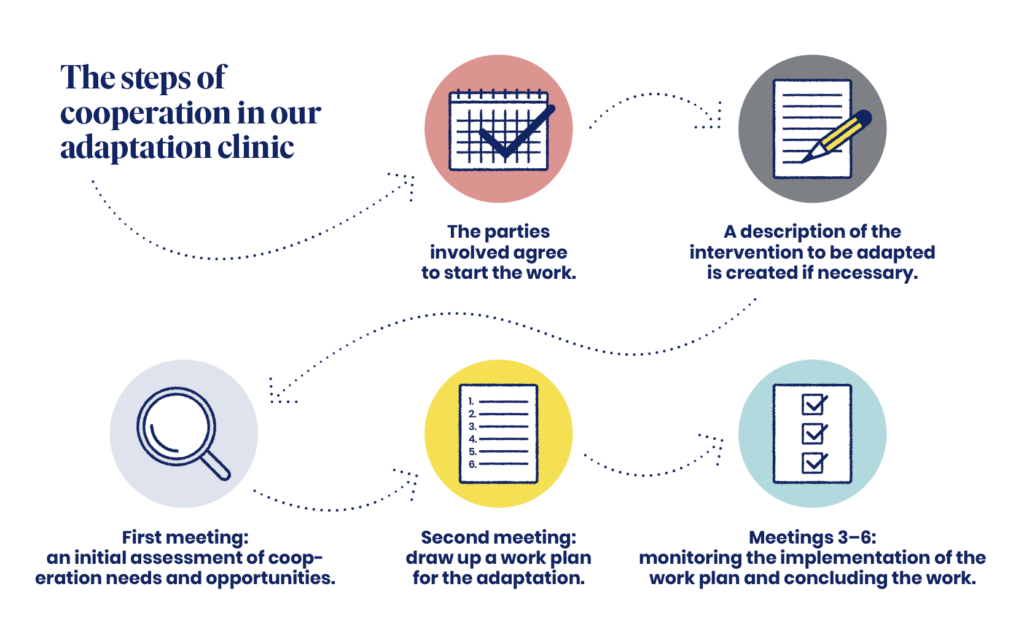
The cooperation starts with an initial assessment meeting (30 minutes) to discuss how the cooperation will be carried out and ensure that we can respond to your needs. In the second meeting (1–2 hours), a work plan for the adaptation is drawn up. Our experts then support the implementation of the work plan as necessary for the subsequent 1–4 meetings. The work is then concluded.
The steps of cooperation in our adaptation clinic
- The parties involved agree to start the work.
- A description of the intervention to be adapted is created if necessary.
- First meeting: an initial assessment of cooperation needs and opportunities.
- Second meeting: draw up a work plan for the adaptation.
- Meetings 3–6: monitoring the implementation of the work plan and concluding the work.
Experiences of cooperation in the adaptation clinic
Case: The University of Helsinki and the Groups 4 Health intervention (2 min – subtitles in English)
Tools for the adaptation of interventions
Information on tools intended for the planning and conducting of adaptation is provided below. Our experts would be happy to support you in using these tools.

ADAPT guidance 1.0
This guide helps you to understand what the adaptation of an intervention is about and what it requires. Read the guide.
Article: the adaptation of psychosocial interventions (in Finnish)
This article explains key adaptation perspectives and concepts in Finnish. Read the article.

ASTAIRE tool
This tool can be used to analyse the transferability of health promotion interventions. Find out more about the ASTAIRE tool and analysing the transferability of interventions in a broader sense (PDF).
FRAME framework
The FRAME framework (FRAME = an expanded framework for reporting adaptations and modifications to evidence-based interventions) can be used to evaluate an intervention’s modification needs already while planning the adaption. Further, it can be used to evaluate and describe the conducted modifications.
Read more about the FRAME framework and its use
- Seilo ym. (2024). Adaptation of interpersonal counselling for adolescent (IPC-A) for Finnish student welfare services – retrospective evaluation by using the framework for reporting adaptations and modifications-enhanced (FRAME). Read the article.
- Chlebowski ym. (2019). Using stakeholder perspectives to guide systematic adaptation of an autism mental health intervention for Latinx families: A qualitative study. Read the article.
- Mui ym. (2023). Analysis of FRAME data (A-FRAME): An analytic approach to assess the impact of adaptations on health services interventions and evaluations. Read the article.
TIDieR checklist
The TIDieR checklist (TIDieR = Template for Intervention Description and Replication) has been developed to improve the quality of the description of interventions in scientific publications. It can be used both in research and as a template for a good intervention description.
Read more about the TiDier checklist and its development
Viisio tool
Itla is developing a tool for evaluating the adaptation needs of interventions. The tool will be published in autumn 2025.
Examples of adaptation descriptions
It is important to carefully describe the adapted intervention so that it can be evaluated and utilised more extensively. Adaptation descriptions can be published on the intervention’s website or in a scientific publication, for example. Well-conducted adaptation can increase commitment to the intervention among professionals and clients.
- Sourander ym. (2024). Cultural adaptation, content, and protocol of a feasibility study of school-based “Let’s learn about emotions” intervention for Finnish primary school children. Read the article.
- Hawke ym. (2023). Lived experience adaptation of a psychosocial intervention for young adults with bipolar spectrum disorders: Process description and adaptation outcomes. Read the article.
- Koivula ym. (2019). Adaptation and Implementation of the German Social-Emotional Learning Program Papilio in Finland: A Pilot Study. Read the article.
- Feinberg ym. (2012). Adaptation of Problem-Solving Treatment for Prevention of Depression Among Low-Income, Culturally Diverse Mothers. Read the article.
Frequently asked questions
- Interventions often include core components that are essential to the intervention’s
effectiveness and should not be modified when adapting the intervention.
Interventions also include flexible components, which professionals may tailor
according to the individual needs of clients. - The programme theory of an intervention describes how and why the intervention is
expected to work. The programme theory helps to understand what needs to be
done to achieve the desired effects. In adaptation, it is ensured that the
modifications made to the intervention do not violate the programme theory. - If the modifications lead to entirely new functions or mechanisms of action, it is
likely that a new intervention is being developed rather than adapting an existing
one. - In some cases, it is unclear whether the modifications, such as moving face-to-face
meetings online or introducing AI-based tools, take you closer to or further away
from the original function of the intervention (the programme theory). This
uncertainty highlights the need to study the adapted intervention in the new context
before its dissemination.
- Before adapting an intervention to a new context, it is necessary to describe its
programme theory if it has not been described yet. The programme theory refers to
information on intervention content and how it is intended to work. - If the original intervention and its mechanisms of change have not been adequately
described, its implementation in the new context may fail and the intervention will
not deliver the outcomes sought. When adapting an intervention to a new context,
there is a risk of replicating only its surface features — such as visible methods or
materials — while overlooking its deeper functions and theoretical foundations. This
often leads to a situation where the external characteristics are preserved, but the
logic behind the techniques, rooted in the original programme theory and core
components, is lost. To avoid this, it may be necessary to first articulate the
programme theory of the original intervention. Doing so enbles informed decisions
about which elements can be meaningfully adapted, ensuring that the intervention
remains effective and faithful to its intended purpose.
- Fidelity means that the intervention is conducted as intended. This is important for
maintaining its effectiveness. - Replicating an intervention completely unchanged is not realistic for psychosocial
interventions: the personality of the professional and the client require flexibility. - From the perspective of adaptation, it is important to identify which components of
the intervention cannot be modified without diminishing its effectiveness. - From the perspective of maintaining fidelity, it is important for the professional who
uses the intervention to know which components of the intervention are flexible and
can be tailored according to the clients individual needs. - Some interventions also involve licence requirements that restrict its adaptation to
different cultures, for example.
- Psychosocial interventions differ in terms of their cultural specificity.
- The need to adapt an intervention depends on assessment of whether the
intervention accessibility and client engagement would be limited among certain
client groups without adaptation. If an intervention involves cultural assumptions
that are incompatible with a different cultural background, that may weaken the
participants’ ability to commit to the intervention.- For example, if the examples in the materials are based on other cultures or
if the client materials are in the language of the majority population.
- For example, if the examples in the materials are based on other cultures or
Contact us
We are interested in engaging international collaboration on the adaptation of psychosocial interventions for children, adolescents and families – feel free to contact us anytime! We provide information on identifying adaptation needs and related risks, as well as research-based tools for adaptation.
We also communicate the importance of adaptation to decision-makers. Information increases understanding and helps to promote the wellbeing of children and adolescents in a changing world.

Erityisasiantuntija
Senior Specialist
Kasvun tuki
nina.mellenius@itla.fi